Emergent Computation Project
Department of Electrical Engineering & Computer Science
University of Tennessee, Knoxville
Emergent computation refers to computational processes —
in natural or artificial systems — in which information processing
and control emerges through the local interaction of large numbers
of relatively simple units. Examples of emergent computation
include information processing in the brain, the “swarm
intelligence” of social insects and other organisms, embryological
morphogenesis (self-organized pattern and structure formation),
and molecular computation (such as DNA computation). The Emergent
Computation Project at the University of Tennessee,
Knoxville investigates emergent computation in natural and
artificial systems and seeks to apply emergent computation in the
design of future computer systems, in AI/robotics, and in
nanotechnology. We currently have several projects in
progress, described below.
- Molecular Combinatory Computation
- Artificial Morphogenesis
- Embodied Computation
- Generalized Computation
- Consciousness Studies
Molecular
Combinatory Computation
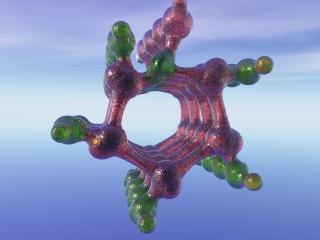
 Molecular
combinatory computation (MCC) is an approach to molecular
computing that makes use of a small set of molecular
building blocks and chemical substitution reactions that together
have the ability to implement arbitrary computations (i.e.,
anything computable on a Turing
machine). Therfore MCC provides a means of
“programming” the assembly of nanostructures and of controlling
their behavior by programmatic means. We have been
investigating MCC by both theoretical analysis and simulation.
Molecular
combinatory computation (MCC) is an approach to molecular
computing that makes use of a small set of molecular
building blocks and chemical substitution reactions that together
have the ability to implement arbitrary computations (i.e.,
anything computable on a Turing
machine). Therfore MCC provides a means of
“programming” the assembly of nanostructures and of controlling
their behavior by programmatic means. We have been
investigating MCC by both theoretical analysis and simulation.
Select Publications & Presentations
- MacLennan, B.J. “A Formal Model of Universal Algorithmic
Assembly and Molecular Computation,” Int’l. Journ. Nanotechnology and Molecular
Computation 2, 3
(July–Sept. 2010), pp. 55–67.
- MacLennan, B.J. “Molecular Combinatory Computing and its
Applications in Nanotechnology.” [old draft: pdf
(800KB)]
- MacLennan, B.J. “Accomplishments and New Directions for 2004:
Progress on Universally Programmable Intelligent Matter — UPIM
Report 10,” UT CS Dept. TR UT-CS-04-531, October 2004. [pdf]
- “Molecular Combinatory Computing for Nanostructure Synthesis
and Control” [postscript
(300 KB), pdf
(800 KB)]: presented at and appears in proceedings of IEEE
Nano 2003, San Francisco, August 12–14, 2003.
- MacLennan, B.J. “Universally Programmable Intelligent Matter:
A Systematic Approach to Nanotechnology” (presentation at IEEE-Nano,
August 28, 2002): Summary for proceedings [postscript,
pdf],
PowerPoint
presentation
For more, please visit the UPIM Project website.
Artificial
Morphogenesis
 A key unsolved problem in nanotechnology
is the assembly of complex 3D hierarchical structures, with
control over the structure from the nanoscale up to the
macroscopic scale. Fortunately nature provides an inspiring
example of how this can be accomplished: morphogenesis
(structure formation) in embryological
development, in which cells divide, differentiate, and
migrate to self-assemble a complete organism. We are
investigating the computational principles of morphogenesis with
the aim of applying artificial morphogenesis to nanotechnology.
A key unsolved problem in nanotechnology
is the assembly of complex 3D hierarchical structures, with
control over the structure from the nanoscale up to the
macroscopic scale. Fortunately nature provides an inspiring
example of how this can be accomplished: morphogenesis
(structure formation) in embryological
development, in which cells divide, differentiate, and
migrate to self-assemble a complete organism. We are
investigating the computational principles of morphogenesis with
the aim of applying artificial morphogenesis to nanotechnology.
Select Publications & Presentations
- MacLennan, B.J. “Embodied Computation: Applying the
Physics of Computation to Artificial Morphogenesis,” Parallel Processing Letters, 22, 3
(2012). [pdf]
- MacLennan,
B.J. “Molecular Coordination of Hierarchical Self-Assembly,”
invited for Nano Communication
Networks Journal, 3, 2 (June 2012), 116–128.
[pdf] http://dx.doi.org/10.1016/j.nancom.2012.01.004
- MacLennan, B.J. “Embodied Computation: Applying the
Physics of Computation to Artificial Morphogenesis,” Proceedings of the Satellite Workshops of
UC 2011, TUCS Lecture Notes No. 14, June 2011,
pp. 9–20.
- MacLennan, B.J. “Models and Mechanisms for Artificial
Morphogenesis,” Natural
Computing, Springer series, Proceedings in Information
and Communications Technology (PICT) 2, ed. by F. Peper, H.
Umeo, N. Matsui, and T. Isokawa, Tokyo: Springer, 2010, pp.
23–33. Invited. Preprint [pdf].
- MacLennan, B.J. “Artificial Morphogenesis as an Example of
Embodied Computation,” International
Journal of Unconventional Computing, 7, 1–2 (2011), pp. 3–23.
- MacLennan,
B.J. “Introduction: Computation and
Nanotechnology,” Theoretical and
Technological Advancements in Nanotechnology and Molecular
Computation: Interdisciplinary Gains, (Bruce
MacLennan, ed.), Hershey, NJ: IGI Global, 2011.
- MacLennan,
B. J. “Morphogenesis as a Model for Nano
Communication,” invited for Nano
Communication Networks Journal 1 (2010),
pp. 199–208. DOI: 10.1016/j.nancom.2010.09.007. [pdf]
- MacLennan, B.J. “Models and Mechanisms for Artificial
Morphogenesis,” Fourth
International Workshop on Natural Computing (IWNC 2009),
Himeji Japan, September 23–25, 2009. Slides [pdf (10 MB)] for
invited presentation.
- MacLennan, B.J. “Configuration and Reconfiguration of Complex
Systems by Artificial Morphogenesis,” Reconfigurable Systems Workshop
2009: Discovery Challenge Thrust, Santa Fe NM, July
20–22, 2009. Sponsored for AFOSR. Slides for invited
presentation [pdf (8 MB)].
- MacLennan, B.J. “A Model of Embodied Computation for
Artificial Morphogenesis,” slides [pdf (5 MB)] for Keynote
Address, IEEE Alife 2009, Mar. 30 – Apr. 2, 2009,
Nashville, TN. A video of this presentation is available
(scroll down).
- MacLennan, B.J. “A Model of Embodied Computation Oriented
Toward Artificial Morphogenesis,” slides [pdf (1 MB)] for invited
talk, The Science and Philosophy of Unconventional
Computing (SPUC09), Mar. 23–25, 2009, Cambridge
University, Cambridge, UK. They are mostly the same as slides
26–60 of the Alife 2009 Keynote.
- MacLennan, B.J. “Embodied Computing,” invitation-only NSF Workshop
on Molecular Communication and Biological Communications
Technology, Arlington, VA, Feb. 20–1, 2008. Slides for
presentation [pdf
(2.1MB)]
Embodied
Computation
Post-Moore’s Law
computing will require an assimilation between computational
processes and their physical realizations, both to achieve greater
speeds and densities and to allow computational processes to
assemble and control matter at the nanoscale. Therefore, we are
investigating embodied computation, which addresses the
essential interrelationships of information processing and
physical processes in the system and its environment in ways that
are parallel to those in the theory of embodied
cognition and behavior-based
robotics. There are both challenges and
opportunities. Analysis is more difficult because physical
effects must be included, but information processing may be
simplified by dispensing with explicit representations and
allowing massively parallel physical processes to process
information. Nevertheless, in order to fully exploit
embodied computation, we need robust and powerful design
methodologies and tools, which are goals of this project.
Select Publications & Presentations
- MacLennan, B.J. “Bodies — Both Informed and Transformed:
Embodied Computation and Information Processing,” invited
submission to Information and
Computation, ed. by Gordana Dodig-Crnkovic and Mark
Burgin, World Scientific Publishing, in press. Unedited preprint
[pdf (1.2 MB)].
- MacLennan, B.J. “A Model of Embodied Computation for
Artificial Morphogenesis,” slides [pdf (5 MB)] for Keynote
Address, IEEE Alife 2009, Mar. 30 – Apr. 2, 2009,
Nashville, TN. A video of this presentation is available
(scroll down).
- MacLennan, B.J. “A Model of Embodied Computation Oriented
Toward Artificial Morphogenesis,” slides [pdf (1 MB)] for invited
talk, The Science and Philosophy of Unconventional
Computing (SPUC09), Mar. 23–25, 2009, Cambridge
University, Cambridge, UK. They are mostly the same as slides
26–60 of the Alife 2009 Keynote.
- MacLennan, B.J. “Challenges of Embodied Artificial
Intelligence and Robotics,” invited for The ITEA Journal of Test and
Evaluation (International Test and Evaluation
Association), 29-4
(Dec. 2008 / Jan. 2009). See also “Test and Evaluation
Challenges of Embodied Artificial Intelligence and Robotics,” UT
EECS Dept. TR UT-CS-08-628, Aug. 22, 2008 [pdf].
- MacLennan, B.J. “Aspects of Embodied Computation: Toward a
Reunification of the Physical and the Formal,” UT EECS Dept. TR
UT-CS-08-610, March 6, 2008; revised Aug. 6, 2008 [pdf]. See also slides
[pdf] from a related
presentation “Embodiment and Non-Turing Models of Computation”
at The
2008 North American Conference on Computing and Philosophy:
The Limits of Computation (The International Association for Computing
and Philosophy, Bloomington, IN, July 10–12, 2008).
- MacLennan,
B.J. “Super-Turing or Non-Turing? Extending the Concept of
Computation,” The International Journal of Unconventional
Computing 5, 3–4
(2009), Special Issue on Future Trends in
Hypercomputation, pp. 369–87. [pdf]
- MacLennan, B.J. “Embodied Computing,” invitation-only NSF Workshop
on Molecular Communication and Biological Communications
Technology, Arlington, VA, Feb. 20–1, 2008. Slides for
presentation [pdf
(2.1MB)]
- MacLennan, B.J. “Self-Organization for Nano-Computation and
Nano-Assembly,” Workshop on Emergent Behavior (WEB 07),
Oak Ridge National Laboratory, Oak Ridge, TN, March 6–7,
2007. Slides for presentation [pdf (10.8 MB)]
Generalized
Computation
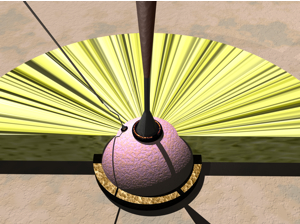
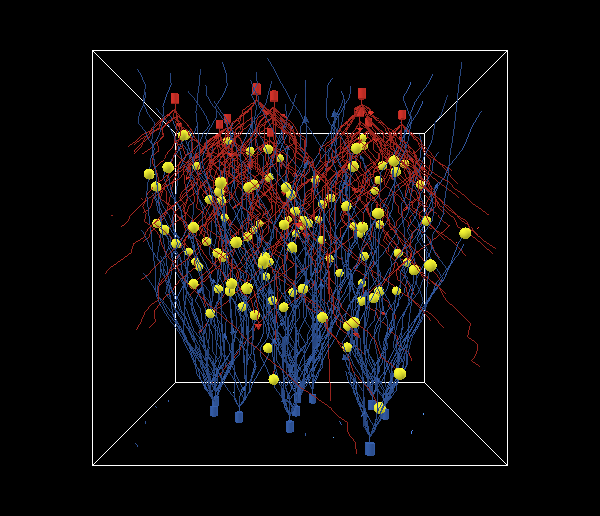 Post-Moore’s Law
computing technology will require the exploitation of new physical
processes for computational purposes, which will be facilitated by
new models of computation. We are developing a model of
generalized computation, and a corresponding machine model (the U-machine),
which
can be applied to massively-parallel nano-computation in bulk
materials. Our first design is able to implement quite general
transformations on a broad class of topological spaces, which
include both analog and digital computation. Neural
morphogenesis provides a model for the physical structure of
the machine and means by which it may be configured, a process
that involves the definition of signal pathways between
two-dimensional data areas and the setting of interconnection
strengths within them. This approach also provides a very flexible
means of reconfiguring
of the internal structure of the machine.
Post-Moore’s Law
computing technology will require the exploitation of new physical
processes for computational purposes, which will be facilitated by
new models of computation. We are developing a model of
generalized computation, and a corresponding machine model (the U-machine),
which
can be applied to massively-parallel nano-computation in bulk
materials. Our first design is able to implement quite general
transformations on a broad class of topological spaces, which
include both analog and digital computation. Neural
morphogenesis provides a model for the physical structure of
the machine and means by which it may be configured, a process
that involves the definition of signal pathways between
two-dimensional data areas and the setting of interconnection
strengths within them. This approach also provides a very flexible
means of reconfiguring
of the internal structure of the machine.
Select Publications & Presentations
- MacLennan, B.J. “The U-Machine: A Model of Generalized
Computation,” International
Journal of Unconventional Computing, in press.
See also UT EECS Dept. Technical Report UT-CS-06-587, Dec. 14,
2006. [pdf (3.4
MB)]
- MacLennan, B.J. “Highly Programmable Matter & Generalized
Computation: Research in Reconfigurable Analog & Digital
Computation in Bulk Materials,” 1st AFRL Reconfigurable
Systems Workshop, Air Force Research Laboratory,
Albuquerque, NM, Feb. 14–15, 2007. Slides for presentation
[pdf (7.3 MB)]
Consciousness
Studies
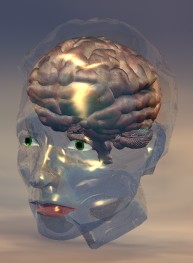 Consciousness is an essential
aspect of intelligence (How intelligently do people act when they
are unconscious?), so we have been investigating the emergence of
consciousness from the combined activity of masses of
neurons. Consciousness is a prerequisite for implementing
intelligent, autonomous robots.
Consciousness is an essential
aspect of intelligence (How intelligently do people act when they
are unconscious?), so we have been investigating the emergence of
consciousness from the combined activity of masses of
neurons. Consciousness is a prerequisite for implementing
intelligent, autonomous robots.
Select Publications
- MacLennan, B.J. “Protophenomena and their Physical Correlates,”
Journal of Cosmology,
2011, Vol. 14. Invited for special issue on consciousness.
- MacLennan, B.J. “Protophenomena: The Elements of Consciousness
and their Relation to the Brain” [preprint
pdf]. Invited for Irreducibly Conscious: Selected
Papers on Consciousness, ed. by Alexander
Batthyány, Avshalom Elitzur & Dimitri Constant,
Heidelberg & New York: Universitätsverlag Winter, 2010,
ch. X (pp. 189–214).
- MacLennan, B.J. “A Protophenomenological Analysis of Synthetic
Emotion in Robots,” UT EECS Dept. TR UT-CS-08-623, Aug. 6, 2008
[pdf]. Unedited draft
of “Robot React, but Can They Feel?” (Handbook of Research on Synthetic Emotions and
Sociable Robotics: New Applications in Affective Computing and
Artificial Intelligence, edited by Jordi
Vallverdú and David Casacuberta, Hershey, NJ: IGI Global,
2009).
- MacLennan, B.J. “Consciousness: Natural and Artificial” [pdf (440KB)]. Invited
for Synthesis Philosophica, Vol. 22 (2008), No. 2, pp.
401–33.
- MacLennan, B.J. “Consciousness in Robots: The Hard Problem and
Some Less Hard Problems (Extended Version),” UT CS Dept. TR
UT-CS-05-553, May 15, 2005. [pdf
(820 KB)] Extended version of paper [pdf
(400K)] presented at 14th IEEE
International Workshop on Robot and Human Interactive
Communication.
- MacLennan, B.J. “The Elements of Consciousness and their
Neurodynamical Correlates,” Journal of
Consciousness Studies, Vol. 3 (1996), Nos. 5/6, pp.
409–24. Reprinted in Explaining Consciousness: The Hard
Problem, Jonathan Shear (Ed.), Cambridge: MIT Press,
1995-7, pp. 249–66. Available as
hypertext and
in pdf form.
- MacLennan, B.J. “ The
Investigation of Consciousness Through Phenomenology and
Neuroscience.” Invited contribution, Scale in
Conscious Experience: Is the Brain Too Important to be Left to
Specialists to Study? Joseph King & Karl H.Pribram
(Eds.), Mahwah: Lawrence-Erlbaum, 1995, pp. 25–43.
 Return to MacLennan’s home
page
Return to MacLennan’s home
page
 Send mail to Bruce
MacLennan / MacLennan@utk.edu
Send mail to Bruce
MacLennan / MacLennan@utk.edu
 This
page
is www.cs.utk.edu/~mclennan/EC/index.html
This
page
is www.cs.utk.edu/~mclennan/EC/index.html
Last updated: 2013-04-18.