 |
Often questions came from a bank -- when that happens, I show the answer to the example exam, and provide grading information for the banks.
|
A: links[2] stays at -1.
B: links[66] becomes 2.
C: sizes[2] adds 24 to 33: 57.
D: sizes[66] stays the same: 24.
Answers to all banks:
key: A B C D ---- -- -- -- -- 0158a -1 43 41 11 08d3b -1 12 57 28 371c0 56 -1 17 44 f7527 -1 2 57 24 |
A: links[0] becomes 4.
B: links[4] stays at -1.
C: heights[0] stays the same: 4.
D: heights[4] also stays the same: 5.
Answers to all banks:
key: A B C D ---- -- -- -- -- 76110 4 -1 4 5 8a751 -1 26 5 4 defb4 24 -1 4 5 8155a -1 4 5 4 |
A: links[4]  = 10
B: links[10] = 44
C: links[16] = 44
D: links[50] = -1
E: links[52] = 33
F: links[67] = 21
Answers to all banks:
key: A B C D E F ---- -- -- -- -- -- -- 2ee9f 56 39 22 10 22 -1 8df0f 10 44 44 -1 33 21 ed5a1 31 42 -1 38 56 42 fe763 34 22 -1 34 6 38 |
 |
Part A: There are 265 ways to have 5 lower-case letters, and 104 ways to have four single numeric digits. Therefore, the answer is: (265)(104).
Part B: This is equal to the number of 6 digit numbers in base 17: (176).
Part C: 17 choose 5, plain and simple: C(17,5) or C(17,12).
Part D: This is equal to the number of permutations of the colors: (12!).
Part E: This is the power set of the juices: (212).
Here are answers to the problems specified by their grading keys (which will be in your exam):
abstract-art-C(14,6) or abstract-art-C(14,8)
band-8!
counters-(7^4)*(2^10)
employee-bonus-2^18
etsy-(2^5)*(3^4)
eyors-5^9
fantasy-9!
flash-cards-9!
gamecard-C(21,8)
garage-C(18,7)
infboxes-6^7
intensity-(2^8)*8!
leds-on-roof-16!
mouse-obstacles-(2^8)*(8!)
office-windows-C(60,40)
pool-chairs-2^25
remote-2^12
sawthee-2^32
shooting-gallery-2^30
thirtovia-13^6
 |
int exactly_n(const vector <int> &sets, int n)
{
  int i, j, num, rv;

  rv = 0;
  for (j = 0; j <= 30; j++) {                 // For each element j
    num = 0;
    for (i = 0; i < sets.size(); i++) {       // For each set i
      if (sets[i] & (1 << j)) num++;          // If element j is in set i, increment num
    }
    if (num == n) rv |= (1 << j);             // If j is in n sets, add it to the return value.
  }
  return rv;
}
|
Grading -- 10 points -- as always, I look for a few things -- correct structure, correct loops, correct use of bit arithmetic. If your grade says "see the answer", it means that you were pretty far off.
 |
This is a binary search. As always, I recommend using start and size to define a region of the numbers where the answer is always in the region. When you get to size ==1 , then the answer is start.
Here's the algorithm in English:
- Set start to 0 and size to 2^50+1 (this is because the answer can be 2^50).
- While size > 1 do the following:
  - Set mid to be start + size/2 - 1.  This will be the last element in the first half of the region.
  - if (fmid) is true, then the answer has to be in the lower half -- set size to size/2.
  - if (fmid) is false, then the answer has to be in the upper half, increment start by size/2 and decrement size by size/2.
- At the end, return start.
Here's code, which follows the description above:
int main();
{
  long long start, size, mid;

  start = 0;
  size = (1LL << 50) + 1;

  while (size > 1) {
    mid = start + size/2 - 1;
    if (f(mid)) {
      size /= 2;
    } else {
      start += size/2;
      size -= size/2;
    }
  }
  printf("%lld\n", start);
}
|
Grading: This was 12 points. If you gave me something that looked like a binary search (code, not English), then you got 6 points. The remaining 6 points were for varying levels of correctness. If I really didn't understand your binary search, I compiled it, and I'm happy to say that there were quite a few solutions that worked when they were compiled (and of course I fixed typos).
There were a few common stumbling blocks:
 |
#include <iostream>
using namespace std;

bool can_i_solve(string &s)
{
  int i;
  int count;

  count = 0;

  /* Count the tees, and if there is only one, you're done -- return true. */

  for (i = 0; i < s.size(); i++) if (s[i] == '1') count++;
  if (count == 1) return true;

  /* Run through all of the tees except for the last two.  You'll look at tees
     i, i+1 and i+2.  If you can make a jump with these three tees, then do so
     and make the recursive call.  Then, if the recursive call failed, undo the
     jump. */

  for (i = 0; i < s.size()-2; i++) {

    /* We first look at situations when there are tees in holes i and i+1, but
       no tee in hole i+2: */

    if (s[i] == '1' && s[i+1] == '1' && s[i+2] == '0') {
      s[i] = '0';
      s[i+1] = '0';
      s[i+2] = '1';
      if (can_i_solve(s)) return true;
      s[i] = '1';
      s[i+1] = '1';
      s[i+2] = '0';
    }

    /* We next look at situations when there are tees in holes i+1 and i+2, but
       no tee in hole i: */

    if (s[i] == '0' && s[i+1] == '1' && s[i+2] == '1') {
      s[i] = '1';
      s[i+1] = '0';
      s[i+2] = '0';
      if (can_i_solve(s)) return true;
      s[i] = '0';
      s[i+1] = '1';
      s[i+2] = '1';
    }
  }

  /* If we get here, then we've failed, so return false. */

  return false;
}

/* Here's testing code -- obviously, you didn't need this, but if you want to
   test my code, then you can copy-paste all of this. */

int main()
{
  string s;

  cin >> s;
  cout << can_i_solve(s) << endl;
  return 0;
}
|
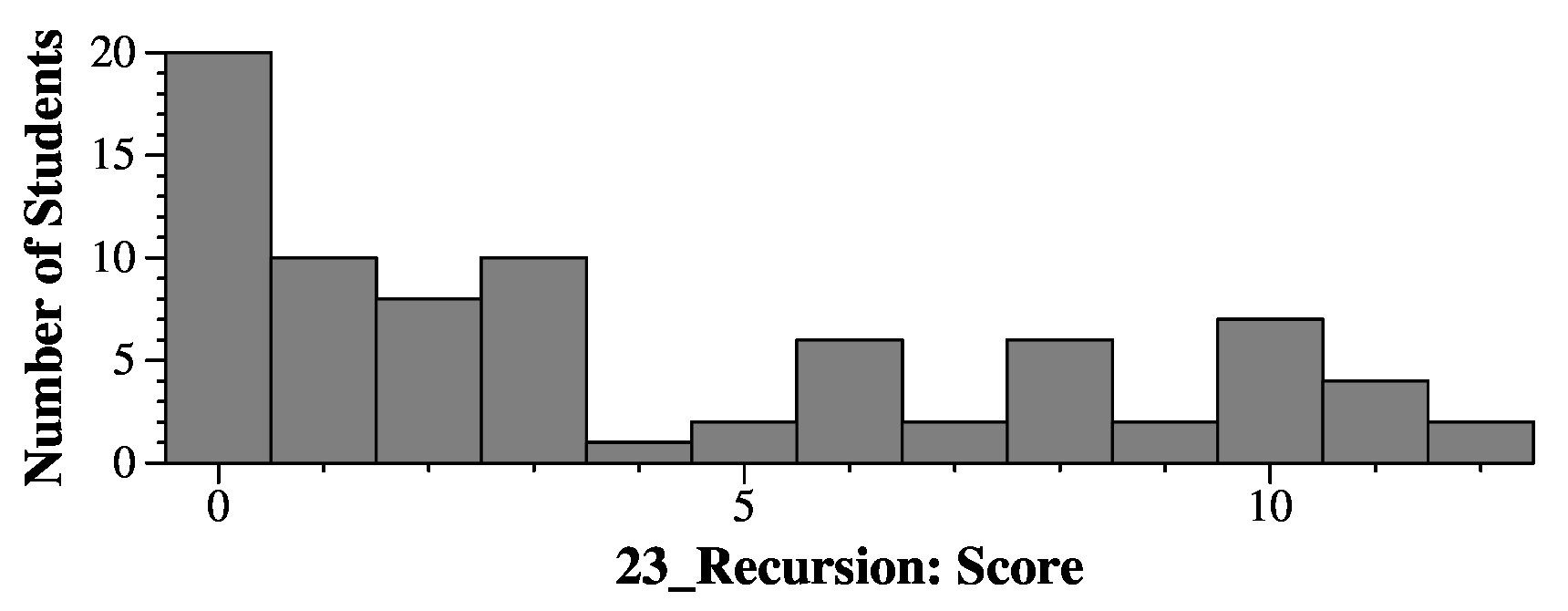
Grading: As with the others -- if you had a basic recursive program with the right structure, you got 6 points. The rest of the points regarded the details. Common problems:
 |